COSTAR Framework for Prompt Engineering: Complete Guide for ChatGPT, Claude & Gemini
Master the COSTAR framework (Context, Objective, Style, Tone, Audience, Response) for AI prompt engineering. Learn when to use COSTAR for marketing copy, professional communications, and content creation with ChatGPT, Claude, and Gemini.
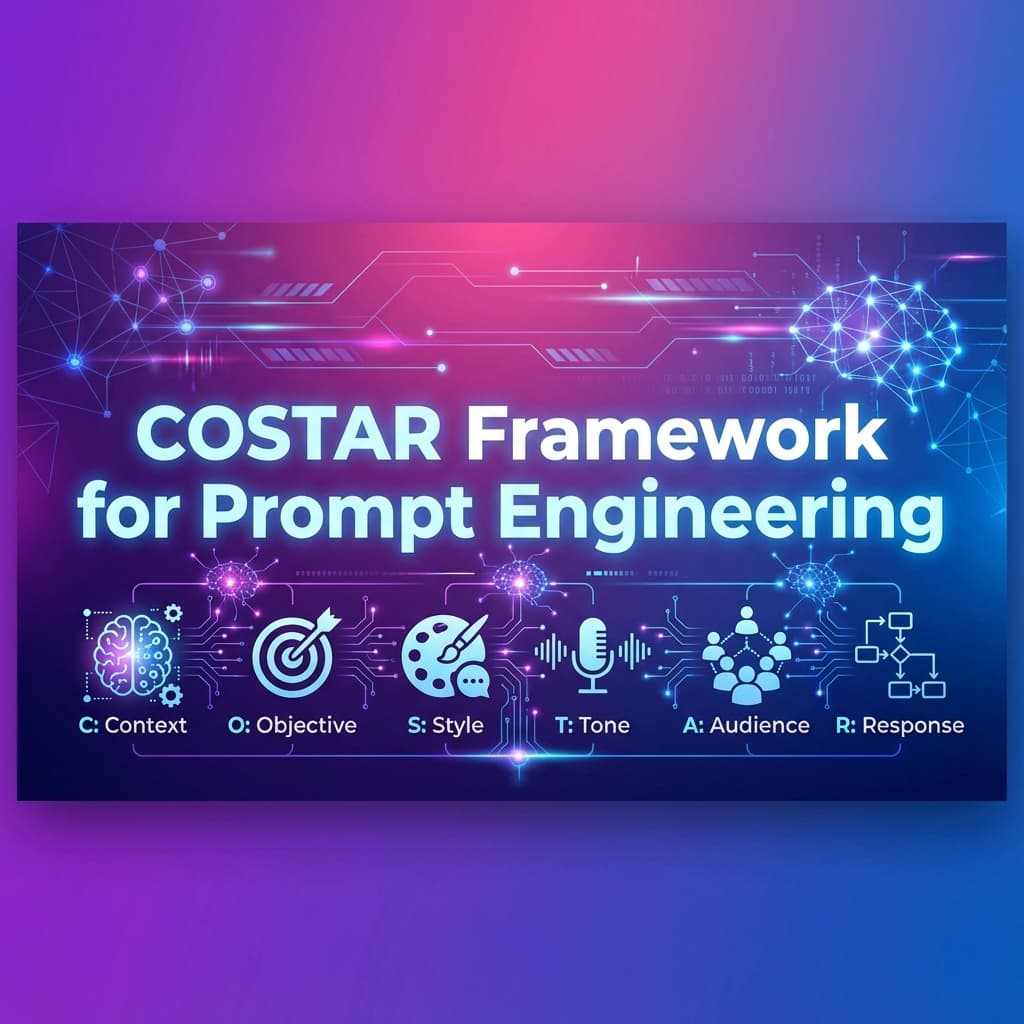
COSTAR Framework for Prompt Engineering: Complete Guide
The COSTAR framework is a comprehensive, audience-aware prompt engineering structure designed for creating detailed, high-quality AI outputs. Perfect for marketing copy, professional communications, and multi-stakeholder content.
What is the COSTAR Framework?
COSTAR is one of the most comprehensive prompt engineering frameworks available, designed to help you create structured, effective prompts that consistently produce professional-grade AI outputs. The acronym stands for Context, Objective, Style, Tone, Audience, and Response — six essential components that transform vague requests into precise, actionable prompts.
Why Use COSTAR?
The COSTAR framework excels when context and audience matter significantly. Unlike simpler frameworks, COSTAR ensures your AI-generated content is:
- Audience-appropriate: Tailored to specific readers or stakeholders
- Contextually relevant: Grounded in real-world situations
- Stylistically consistent: Matching your brand or communication style
- Tonally appropriate: Conveying the right emotional quality
The Six COSTAR Components Explained
C - Context: Set the Scene
Context provides the background information and situational details the AI needs to understand your request fully.
Why it matters: Without context, AI models make assumptions that may not align with your needs. Context ensures the AI understands the "why" behind your request.
Example:
- ❌ Poor: "Write about our product"
- ✅ Good: "We're launching a new AI-powered scheduling tool for remote teams struggling with timezone coordination"
O - Objective: Define the Goal
Objective specifies the exact task or goal you want the AI to accomplish.
Why it matters: Clear objectives prevent scope creep and ensure the AI focuses on what you actually need.
Example:
- ❌ Poor: "Help with marketing"
- ✅ Good: "Create a landing page headline and subheadline that converts visitors into trial signups"
S - Style: Choose Your Approach
Style defines the writing style or approach — formal, casual, technical, creative, journalistic, etc.
Why it matters: Style consistency builds brand recognition and ensures content fits your existing materials.
Example:
- ❌ Poor: "Write it well"
- ✅ Good: "Use a conversational, friendly style similar to Mailchimp's blog — approachable but professional"
T - Tone: Set the Emotional Quality
Tone specifies the emotional quality of the response — enthusiastic, professional, empathetic, urgent, calm, etc.
Why it matters: Tone influences how your message is received and can dramatically affect conversion rates and engagement.
Example:
- ❌ Poor: "Make it sound good"
- ✅ Good: "Encouraging and optimistic, but realistic about limitations — avoid hype"
A - Audience: Know Your Readers
Audience identifies who will be reading or using the output — their expertise level, interests, pain points, and demographics.
Why it matters: Content that resonates with one audience may completely miss the mark with another. Audience awareness is critical for effectiveness.
Example:
- ❌ Poor: "For everyone"
- ✅ Good: "Small business owners (10-50 employees) with no technical background, frustrated by manual scheduling"
R - Response: Specify the Format
Response defines the format and structure of the desired output — length, structure, formatting, deliverables.
Why it matters: Clear format specifications prevent the AI from delivering the right content in the wrong package.
Example:
- ❌ Poor: "Give me some content"
- ✅ Good: "A 500-word blog post with: catchy headline, 3-paragraph intro, 4 benefit sections (150 words each), and a CTA"
COSTAR in Action: Before & After
Before (Vague Prompt)
Write me a blog post about AI
Result: Generic, unfocused content that doesn't serve any specific purpose.
After (COSTAR-Structured Prompt)
**Context:** I run a tech blog for small business owners who are curious about AI but intimidated by technical jargon. My readers are actively looking for practical ways to improve their businesses.

**Objective:** Write a blog post explaining how AI can help automate repetitive business tasks, focusing on immediate, actionable applications.

**Style:** Conversational and accessible, avoiding technical jargon. Use analogies and real-world examples. Similar to Harvard Business Review's accessible style.

**Tone:** Encouraging and optimistic, but realistic about limitations. Empathetic to concerns about job displacement and complexity.

**Audience:** Small business owners (5-50 employees) with no technical background. They're time-strapped, budget-conscious, and skeptical of "too good to be true" solutions.

**Response:** An 800-word blog post with:
- Engaging headline (under 60 characters)
- Hook introduction (2-3 paragraphs)
- 3-4 practical examples with specific tools
- Implementation difficulty rating for each
- Conclusion with next steps
- Call-to-action linking to our AI tools guide
Result: Targeted, actionable content that speaks directly to your audience's needs and concerns.
When to Use COSTAR Framework
COSTAR is best for situations where context and audience significantly impact the quality of the output:
✅ Ideal Use Cases
-
Marketing Copy & Advertising
- Landing pages
- Email campaigns
- Ad copy
- Product descriptions
- Sales presentations
-
Professional Communications
- Client proposals
- Business reports
- Executive summaries
- Stakeholder updates
- Press releases
-
Multi-Stakeholder Content
- Internal communications
- Training materials
- Policy documents
- Change management communications
-
Content Creation
- Blog posts
- Articles
- White papers
- Case studies
- Social media content
-
Creative Work
- Brand storytelling
- Scripts
- Narratives
- Thought leadership pieces
❌ When NOT to Use COSTAR
- Quick, simple tasks — Use TAG or RTF instead
- Technical code generation — Use Code Assistant framework
- Step-by-step procedures — Use RISEN framework
- When audience is irrelevant — Use simpler frameworks
COSTAR vs. Other Frameworks
| Framework | Best For | Complexity | Audience Focus |
|---|---|---|---|
| COSTAR | Marketing, communications, multi-stakeholder content | High | ⭐⭐⭐ Critical |
| RTF | Quick tasks, data analysis | Low | ⭐ Minimal |
| RISEN | Complex procedures, tutorials | High | ⭐⭐ Moderate |
| CARE | Business requests, problem-solving | Medium | ⭐⭐ Moderate |
| TAG | Simple queries, quick tasks | Low | ⭐ Minimal |
Real-World COSTAR Examples
Example 1: Product Launch Email
**Context:** We're launching our new AI scheduling tool next week. Our email list consists of 10,000 subscribers who signed up for productivity tips.

**Objective:** Create a product launch email that drives trial signups while maintaining our helpful, non-salesy brand voice.

**Style:** Friendly and conversational, like an email from a colleague sharing a useful tool they discovered.

**Tone:** Excited but not pushy. Helpful and genuine.

**Audience:** Busy professionals (25-45) who value productivity and are open to new tools but skeptical of overhyped products.

**Response:** Email with:
- Subject line (under 50 chars)
- Preview text (under 100 chars)
- Body (200-300 words)
- Single clear CTA button
- P.S. with social proof
Example 2: Technical Documentation
**Context:** Our API has complex authentication requirements that developers frequently misconfigure, leading to support tickets.

**Objective:** Create API authentication documentation that reduces setup errors and support tickets.

**Style:** Technical but clear. Step-by-step with code examples. Similar to Stripe's documentation style.

**Tone:** Helpful and patient. Anticipate common mistakes without being condescending.

**Audience:** Backend developers (junior to mid-level) implementing our API for the first time. Familiar with REST APIs but not our specific system.

**Response:** Documentation page with:
- Quick start guide (5 steps)
- Detailed explanation of each auth method
- Code examples in Python, JavaScript, and Ruby
- Common errors and solutions
- Security best practices section
Using COSTAR in PromptBoost
PromptBoost has the COSTAR framework built-in as a native template. Here's how to use it:
- Select COSTAR from the Frameworks menu
- Fill in each component using the guided interface
- Preview your structured prompt
- Generate the optimized prompt
- Copy and use with ChatGPT, Claude, Gemini, or any AI model
PromptBoost automatically formats your COSTAR components into a well-structured prompt that AI models understand perfectly.
COSTAR Best Practices
Do's ✅
- Be specific in each component — vague inputs produce vague outputs
- Include examples when describing style or tone
- Define audience pain points not just demographics
- Specify measurable objectives when possible
- Reference existing content for style matching
Don'ts ❌
- Don't skip components — each serves a purpose
- Don't use jargon in audience descriptions
- Don't be vague about desired format
- Don't assume the AI knows your context
- Don't mix multiple audiences in one prompt
SEO Benefits of COSTAR
Using COSTAR for content creation improves SEO by:
- Audience targeting → Better keyword alignment
- Clear objectives → Focused, relevant content
- Tone specification → Consistent brand voice
- Format definition → Proper content structure
- Context inclusion → Comprehensive, authoritative content
Conclusion
The COSTAR framework is your go-to choice for marketing copy, professional communications, and any content where audience and context significantly impact quality. While it requires more upfront thinking than simpler frameworks, the results are consistently professional, targeted, and effective.
Key Takeaways:
- Use COSTAR when audience and context matter
- All six components work together for best results
- Perfect for marketing, communications, and creative work
- Built into PromptBoost for instant use
Ready to create professional, audience-aware prompts? Get PromptBoost and access the COSTAR framework instantly, along with 17 other specialized prompt engineering frameworks.
Ready to Transform Your Prompts?
PromptBoost has all these frameworks built-in. Start creating professional prompts in seconds.
Get PromptBoost Now