Context Engineering: The Next Evolution Beyond Prompt Engineering
Discover context engineering—the evolution beyond basic prompt engineering. Learn how AI agents, multi-turn conversations, RAG, and system prompts are changing how we interact with AI, and what it means for everyday users and developers.
Context Engineering: The Next Evolution Beyond Prompt Engineering
Prompt engineering has dominated AI conversations for the past two years. But there's a quiet shift happening—one that will fundamentally change how we interact with AI.
Welcome to the era of context engineering.
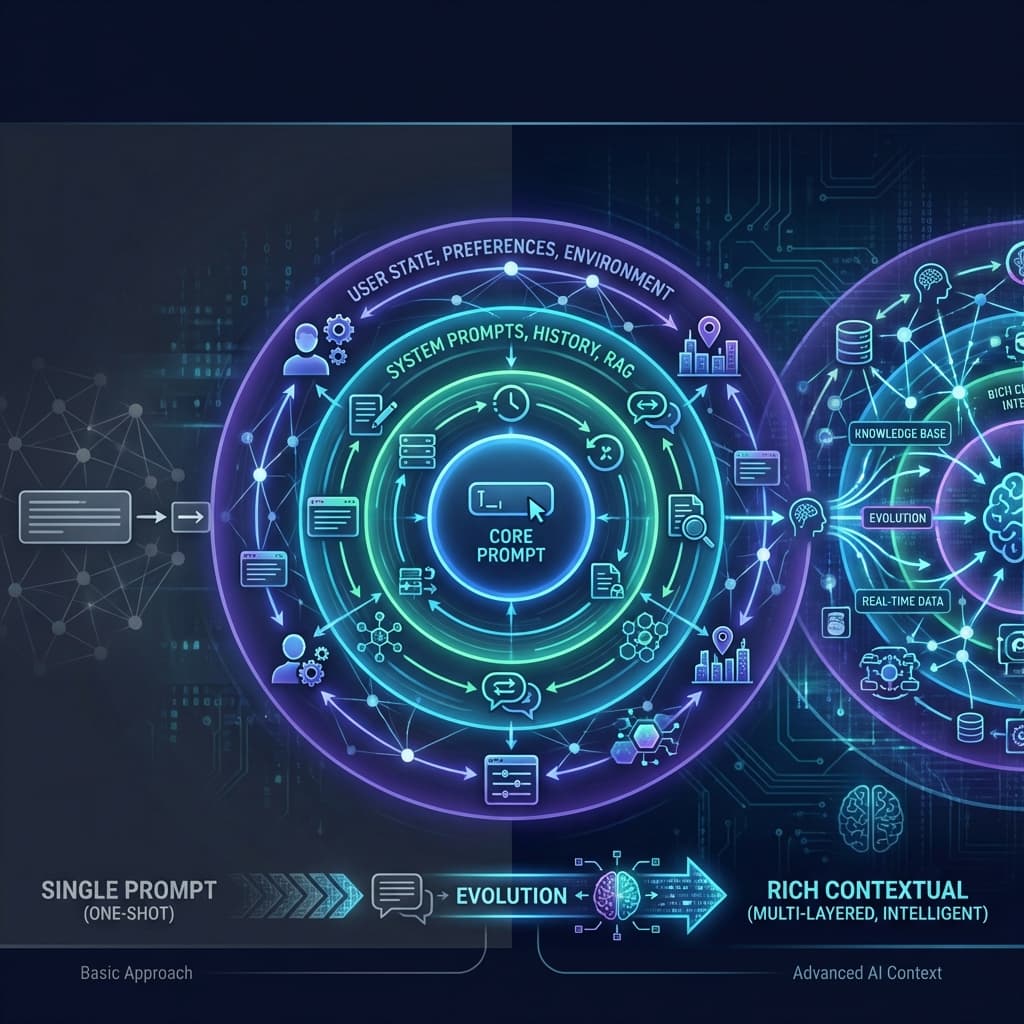
If prompt engineering is about crafting the perfect single instruction, context engineering is about orchestrating entire conversations, managing state, and building systems where AI understands not just what you're asking now, but everything that came before.
This isn't just theoretical. It's already happening with AI agents, multi-turn conversations, and tools like ChatGPT's memory feature. And it has massive implications for how you'll use AI in the future.
The Rise of AI Agents and Multi-Turn Conversations
Traditional prompt engineering assumes a simple model:
- You write a prompt
- AI generates a response
- Done
But modern AI workflows look different:
- You start a conversation
- AI responds
- You refine based on the response
- AI builds on previous context
- You add new information
- AI integrates everything
- This continues for dozens of turns
Example: You're not just asking ChatGPT to "write a blog post." You're:
- Brainstorming topics
- Refining the angle
- Generating an outline
- Drafting sections
- Editing based on feedback
- Optimizing for SEO
- Creating social media versions
Each step builds on the previous one. The AI needs to remember your preferences, your audience, your brand voice, and all the decisions made earlier.
This is context engineering.
What Is Context Engineering? (Anthropic's Framing)
Anthropic (creators of Claude) introduced the term "context engineering" to describe this shift. Here's their key insight:
"As AI systems become more capable and are used for more complex tasks, the quality of outputs depends less on individual prompts and more on the entire context provided to the model."
Context includes:
- System prompts (instructions that persist across the conversation)
- Conversation history (everything said so far)
- Retrieved information (documents, data, external knowledge via RAG)
- User state (preferences, past behavior, settings)
- Environmental context (time, location, device, etc.)
Prompt engineering optimizes the question. Context engineering optimizes the entire environment in which the question is asked.
Why Prompts Alone Aren't Enough for Complex AI Applications
Let's look at a real-world example: a customer support AI agent.
Prompt Engineering Approach (Limited)
Prompt:
You are a customer support agent. Answer this question: "How do I reset my password?"
Problem: The AI has no context about:
- Which product the customer is using
- Whether they've tried resetting before
- Their account status
- Previous support interactions
- Their technical skill level
Result: Generic, one-size-fits-all response.
Context Engineering Approach (Powerful)
System Prompt:
You are a customer support agent for [Company]. You have access to:
- Customer account information
- Previous support tickets
- Product usage history
- Knowledge base articles

Always:
- Personalize responses based on customer history
- Escalate to human agents for billing issues
- Provide step-by-step instructions for non-technical users
- Link to relevant help articles
Retrieved Context (RAG):
- Customer name: Sarah
- Product: Premium plan
- Previous tickets: 2 (both resolved)
- Last login: 2 hours ago
- Technical level: Beginner (based on past interactions)
Conversation History:
Customer: "I can't log in"
Agent: "I can help with that. Are you getting an error message?"
Customer: "It says my password is wrong"
Agent: "Let me help you reset it. I see you're on our Premium plan..."
Current Question:
"How do I reset my password?"
Now the AI can provide a personalized, contextual response:
- Addresses Sarah by name
- Knows she's already tried logging in
- Understands she's a beginner (provides detailed steps)
- Can check if there are any account issues
- Remembers this is her third support interaction
This is the power of context engineering.
Key Components of Effective Context
1. System Prompts
What they are: Persistent instructions that apply to every interaction.
Example for a coding assistant:
You are an expert Python developer who prioritizes:
- Clean, readable code following PEP 8
- Comprehensive error handling
- Type hints for all functions
- Docstrings explaining purpose and parameters
- Unit tests for critical functions

When generating code:
- Always include error handling
- Explain your design decisions
- Suggest optimizations when relevant
- Warn about potential edge cases
This system prompt shapes every response without needing to repeat it in each individual prompt.
2. Conversation History
What it is: The full record of the conversation so far.
Why it matters: The AI can:
- Build on previous answers
- Remember your preferences
- Avoid repeating information
- Maintain consistency across responses
Example:
User: "I'm building a web app for small businesses"
AI: "Great! What features are you planning?"
User: "Invoicing and client management"
AI: "For invoicing, I recommend..."
User: "What about the client management part?"
AI: [Remembers the context: small business web app, already discussed invoicing]
3. Retrieved Information (RAG)
What it is: Retrieval-Augmented Generation—pulling in external information relevant to the query.
How it works:
- User asks a question
- System searches a knowledge base/database
- Relevant documents are retrieved
- AI uses those documents to inform its response
Example use cases:
- Customer support (retrieve help articles)
- Research assistants (retrieve papers, documents)
- Code assistants (retrieve documentation, examples)
- Legal/medical AI (retrieve case law, medical literature)
Why it's powerful: The AI isn't limited to its training data. It can access up-to-date, domain-specific information.
4. User State and Preferences
What it is: Information about the user that persists across sessions.
Examples:
- Preferred communication style (formal vs. casual)
- Technical expertise level
- Language preferences
- Previous projects or interests
- Frequently used frameworks or tools
Impact: Every interaction becomes more personalized over time.
Implications for Everyday Users
What this means for you:
1. Conversations > One-Off Prompts
Instead of crafting the perfect single prompt, focus on building effective conversations:
- Start broad, then refine
- Provide feedback on outputs
- Add context as you go
- Let the AI ask clarifying questions
2. Memory and Persistence Matter
Tools with memory (like ChatGPT's custom instructions or Claude's Projects) become more valuable:
- Set your preferences once
- AI remembers your style, audience, and goals
- No need to repeat context every time
3. Multi-Step Workflows Become Easier
Complex tasks that require multiple steps benefit most:
- Research → Outline → Draft → Edit → Optimize
- Brainstorm → Refine → Implement → Test → Document
- Analyze → Visualize → Interpret → Report
The AI maintains context across all steps.
Implications for Developers
What this means for building AI applications:
1. System Prompts Are Your Foundation
Invest time in crafting comprehensive system prompts:
- Define the AI's role and capabilities
- Set quality standards
- Establish constraints and safety guidelines
- Provide domain-specific knowledge
2. RAG Is Essential for Specialized Applications
If your AI needs access to:
- Company-specific knowledge
- Up-to-date information
- Large document collections
- Proprietary data
You need RAG. Prompts alone won't cut it.
3. State Management Becomes Critical
Track:
- User preferences and history
- Conversation context
- Retrieved documents
- Intermediate results
Poor state management = poor user experience.
4. Evaluation Shifts
You're no longer just evaluating individual prompt/response pairs. You're evaluating:
- Multi-turn conversation quality
- Context retention across sessions
- Personalization effectiveness
- RAG retrieval accuracy
How Structured Frameworks Help Manage Context
Even in the context engineering era, frameworks like COSTAR and RISEN remain valuable—but their role evolves.
Old role: Structure individual prompts New role: Structure system prompts and conversation templates
Example: COSTAR for System Prompts
Context: You are an AI writing assistant for a content marketing agency.
Your users are marketers creating blog posts, social media content, and
email campaigns for B2B SaaS companies.

Objective: Help users create high-quality, on-brand content efficiently
while maintaining consistency across all deliverables.

Style: Professional but conversational. Use clear, jargon-free language
unless the user requests technical depth.

Tone: Helpful and encouraging. Assume users are busy and value efficiency.

Audience: Marketing professionals with varying levels of writing experience,
from junior marketers to CMOs.

Response: Always provide:
- Clear, actionable suggestions
- Multiple options when appropriate
- Explanations for your recommendations
- Next steps or follow-up questions
This system prompt provides context for every interaction, not just one.
The Future: Will AI Eventually Understand Without Prompts?
Here's the provocative question: If context engineering becomes sophisticated enough, do we even need prompts?
Imagine an AI that:
- Knows your goals and preferences
- Understands your work context
- Has access to all relevant information
- Learns from every interaction
- Anticipates your needs
You might just say: "Help me with the Q1 campaign" and it knows exactly what to do.
We're not there yet. But we're moving in that direction.
For now: The better you are at providing context (through system prompts, conversation history, and retrieved information), the less you need to craft perfect individual prompts.
Practical Tips for Context Engineering Today
For Everyday Users:
-
Use tools with memory/custom instructions
- Set your preferences once
- Let the AI remember your style and needs
-
Build conversations, not one-off prompts
- Start broad, refine iteratively
- Provide feedback and corrections
- Add context as you go
-
Organize your AI interactions by project
- Use ChatGPT Projects, Claude Projects, or similar features
- Keep related conversations together
- Build context over time
For Developers:
-
Invest in comprehensive system prompts
- Define role, capabilities, and constraints
- Provide domain knowledge
- Set quality standards
-
Implement RAG for specialized knowledge
- Don't rely solely on the model's training data
- Retrieve relevant documents dynamically
- Keep your knowledge base updated
-
Track conversation state
- Maintain user preferences
- Store conversation history
- Manage retrieved context
-
Test multi-turn interactions
- Don't just test single prompts
- Evaluate full conversation flows
- Measure context retention
PromptBoost and Context Engineering
While PromptBoost focuses on prompt management and versioning, we're building with context engineering in mind:
- Project-based organization (group related prompts together)
- System prompt templates (reusable context for conversations)
- Conversation tracking (see how prompts evolve in multi-turn interactions)
- Context snippets (save reusable context blocks)
Because the future isn't just about individual prompts—it's about managing entire AI workflows.
Your Action Plan: Start Thinking in Context
-
Audit your current AI usage
- How many one-off prompts vs. conversations?
- Are you repeating context unnecessarily?
-
Set up custom instructions/system prompts
- Define your preferences once
- Let the AI remember your style
-
Organize by project, not by prompt
- Group related work together
- Build context over time
-
Experiment with multi-turn workflows
- Break complex tasks into conversations
- Refine iteratively instead of trying to get it perfect in one shot
Or let PromptBoost help you manage both prompts and context efficiently.
The bottom line: Prompt engineering isn't dead—it's evolving. The future belongs to those who can orchestrate entire contexts, not just craft individual prompts.
Context engineering is the next frontier. Start learning it now.
Ready to level up your AI workflow? Get PromptBoost and manage prompts, context, and conversations in one place.
Ready to Transform Your Prompts?
PromptBoost has all these frameworks built-in. Start creating professional prompts in seconds.
Get PromptBoost Now