CARE Framework for Prompt Engineering: Context, Action, Result, Example Guide
Master the CARE framework (Context, Action, Result, Example) for action-oriented AI prompting. Perfect for business requests, problem-solving, and tasks where examples improve output quality with ChatGPT, Claude, and Gemini.
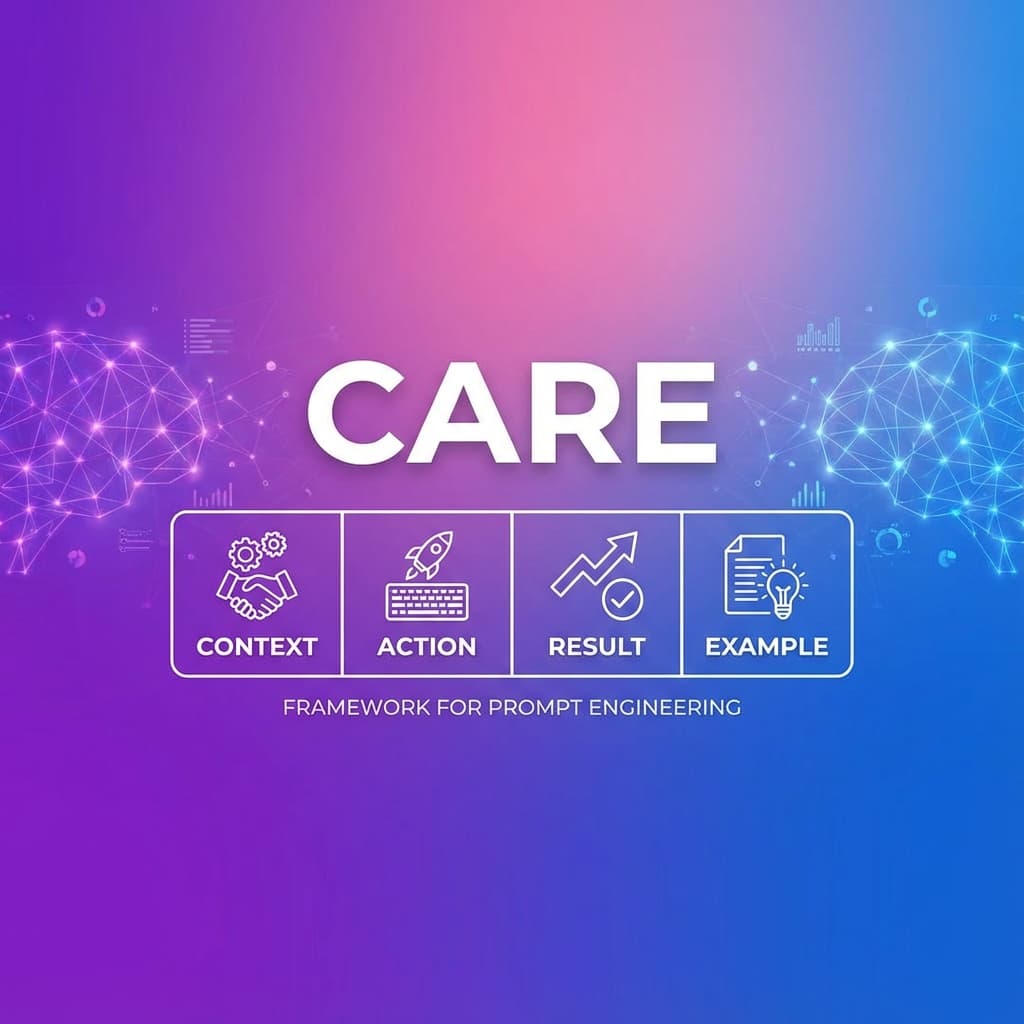
CARE Framework: Action-Oriented AI Prompting Made Simple
The CARE framework is an action-oriented prompt engineering structure designed for business requests and problem-solving scenarios. Perfect for tasks where examples significantly improve output quality.
What is the CARE Framework?
CARE is a practical, business-focused prompt engineering framework that emphasizes action and results. The acronym stands for Context, Action, Result, and Example — four components that transform business requests into clear, actionable AI prompts.
Why Use CARE?
The CARE framework is best for business requests, problem-solving scenarios, and tasks where providing examples dramatically improves output quality:
- Action-focused: Emphasizes what needs to be done
- Results-oriented: Defines clear outcomes
- Example-driven: Optional examples clarify expectations
- Business-friendly: Perfect for professional contexts
Unlike comprehensive frameworks like COSTAR or RISEN, CARE is streamlined for business efficiency while maintaining enough structure for quality outputs.
The Four CARE Components Explained
C - Context: Set the Business Situation
Context provides the background information and business situation the AI needs to understand.
Why it matters: Business decisions require context. Without it, AI solutions may be technically correct but practically useless.
Examples:
- "Our SaaS product has 10K users but churn rate increased from 5% to 12% last quarter"
- "We're launching in a new market where our brand is unknown"
- "Our support team is overwhelmed with 500+ tickets/day, 60% are repetitive questions"
A - Action: Define What Needs to Be Done
Action specifies the concrete action or task you want the AI to perform.
Why it matters: Clear actions produce focused results. Vague actions waste time with irrelevant outputs.
Examples:
- ❌ Poor: "Help with churn"
- ✅ Good: "Create a 3-month churn reduction strategy focusing on the first 30 days of user onboarding"
Best practices:
- Use specific action verbs (create, analyze, design, develop)
- Include scope and timeframe
- Mention key focus areas
- Define deliverables
R - Result: Specify the Desired Outcome
Result clearly states what success looks like and what you expect to receive.
Why it matters: Defining results prevents misalignment and ensures the AI delivers what you actually need.
Examples:
- "A detailed strategy document with 5-7 specific tactics, implementation timeline, and expected impact"
- "Three alternative pricing models with pros/cons and revenue projections"
- "A prioritized list of 10 features with effort estimates and business value scores"
E - Example: Provide Clarifying Examples (Optional)
Example offers optional examples that clarify your expectations, style, or desired approach.
Why it matters: Examples are worth a thousand words. They show rather than tell, dramatically improving output quality.
When to include examples:
- When style/tone is important
- When format is complex
- When you have a preferred approach
- When past work can guide future work
Examples:
- "Similar to how Slack approaches onboarding with progressive disclosure"
- "Like this competitor's pricing page: [URL]"
- "In the style of our previous campaign: [example]"
CARE in Action: Before & After
Before (Vague Prompt)
We need to reduce customer churn
Result: Generic advice without actionable specifics.
After (CARE-Structured Prompt)
**Context:** Our B2B SaaS product (project management tool) has 10K users. Churn increased from 5% to 12% last quarter. Data shows 70% of churned users never completed initial setup, and 80% churned within first 60 days. Our main competitors have 6-8% churn.

**Action:** Create a comprehensive churn reduction strategy focused on improving the first 60 days of user experience, with specific tactics for increasing setup completion and early engagement.

**Result:** Deliver a strategy document including:
- 5-7 specific tactics with implementation details
- 90-day implementation timeline
- Resource requirements (team, budget, tools)
- Expected impact on churn rate
- Success metrics and tracking plan

**Example:** Reference Notion's onboarding approach — they use templates, interactive tutorials, and progressive feature introduction. We want a similar philosophy adapted to our project management context.
Result: Actionable, specific strategy tailored to your situation with clear implementation path.
When to Use CARE Framework
CARE is best for business requests and problem-solving where examples improve quality:
✅ Ideal Use Cases
-
Business Strategy
- Growth strategies
- Market entry plans
- Competitive analysis
- Business model design
- Pricing strategies
-
Problem-Solving
- Churn reduction
- Conversion optimization
- Process improvements
- Cost reduction
- Quality improvements
-
Product Development
- Feature prioritization
- Product roadmaps
- User research plans
- MVP definitions
- Go-to-market strategies
-
Marketing & Sales
- Campaign strategies
- Content plans
- Sales processes
- Lead generation
- Customer segmentation
❌ When NOT to Use CARE
- Complex multi-step procedures — Use RISEN instead
- Audience-specific content — Use COSTAR instead
- Simple quick tasks — Use TAG instead
- Code generation — Use Code Assistant framework
- When examples aren't helpful — Use RTF instead
CARE vs. Other Frameworks
| Framework | Best For | Business Focus | Example Support |
|---|---|---|---|
| CARE | Business requests, problem-solving | ⭐⭐⭐ High | ⭐⭐⭐ Built-in |
| COSTAR | Marketing, communications | ⭐⭐ Medium | ⭐ Optional |
| RTF | Content creation, data analysis | ⭐⭐ Medium | ⭐ None |
| RISEN | Tutorials, procedures | ⭐ Low | ⭐ None |
| TAG | Quick tasks | ⭐ Low | ⭐ None |
Real-World CARE Examples
Example 1: Business Strategy
**Context:** We're a 50-person SaaS company with $5M ARR. We've been successful in the US market (tech startups) but growth is slowing. We're considering expanding to Europe but have zero brand recognition there and limited budget ($200K for year 1).

**Action:** Develop a market entry strategy for expanding to the UK and Germany, focusing on cost-effective customer acquisition and brand building within our budget constraints.

**Result:** Provide:
- Market entry strategy with 3-phase approach
- Customer acquisition channels ranked by cost-effectiveness
- Year 1 budget allocation across channels
- Localization requirements (product, marketing, support)
- Success metrics and milestones for each phase
- Risk assessment and mitigation strategies

**Example:** Reference how Notion entered European markets — they focused on community building, localized content marketing, and strategic partnerships rather than paid advertising. We want a similar low-cost, high-impact approach.
Example 2: Problem-Solving
**Context:** Our customer support team (5 people) handles 500+ tickets daily. 60% are repetitive questions about password resets, billing, and basic features. Average response time is 8 hours, but customers expect <2 hours. Team is burned out and we're losing customers due to slow support.

**Action:** Design a support optimization strategy that reduces repetitive tickets by 50% and improves response time to under 2 hours, without hiring additional support staff.

**Result:** Deliver an optimization plan including:
- Self-service solutions (knowledge base, chatbot, FAQs)
- Ticket routing and prioritization system
- Automation opportunities for common issues
- Implementation timeline (90 days)
- Cost estimate for tools/solutions
- Expected impact on ticket volume and response time

**Example:** Intercom's approach — they use a combination of help center articles, chatbot for common questions, and smart routing for complex issues. We want a similar tiered support system.
Using CARE in PromptBoost
PromptBoost includes CARE as a built-in framework:
- Select CARE from the Frameworks menu
- Provide context — Describe the business situation
- Define action — Specify what needs to be done
- State result — Define the desired outcome
- Add example (optional) — Clarify with examples
- Generate and use with any AI model
CARE Best Practices
Do's ✅
- Include relevant metrics in context — Numbers matter
- Be specific with actions — "Create a strategy" vs "Help"
- Define measurable results — Quantify when possible
- Use examples strategically — Show, don't just tell
- Focus on business outcomes — Not just activities
Don'ts ❌
- Don't skip context — It's critical for relevance
- Don't use vague actions — Be specific
- Don't forget to define results — Clarity prevents rework
- Don't overuse examples — One good example > three mediocre ones
- Don't ignore constraints — Budget, time, resources matter
Conclusion
The CARE framework is your go-to choice for business requests and problem-solving where examples significantly improve output quality. It's action-oriented, results-focused, and business-friendly.
Key Takeaways:
- Use CARE for business requests and problem-solving
- Examples dramatically improve output quality
- Perfect balance of structure and simplicity
- Built into PromptBoost for instant use
Ready to solve business problems with AI? Get PromptBoost and access CARE along with 17 other specialized prompt engineering frameworks.
Ready to Transform Your Prompts?
PromptBoost has all these frameworks built-in. Start creating professional prompts in seconds.
Get PromptBoost Now